
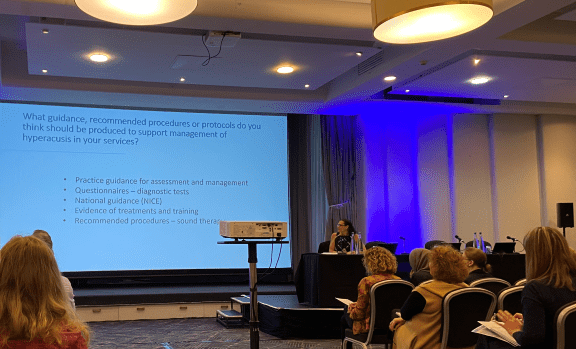
Speakers at the British Society of Audiology Scientific Meeting (June 2023) highlighted current research on hyperacusis. A UK national service evaluation for hyperacusis was conducted by the BSA’s special interest group on Tinnitus & Hyperacusis at the University of Nottingham’s Biomedical Research Centre.
Services helping patients had a range of experience in treating hyperacusis from 1 year to 35 years, most patients were referred to services by their GP and waiting times varied from 1 week to 22 weeks. The assessment of hyperacusis involved patient interviews, otoscopy (when a medical device is used to look into the ears), and other audiology tests and questionnaires. However, practitioners stated that there were no standardised criteria used to establish a formal diagnosis of hyperacusis.
Management of hyperacusis in adults included educating patients and offering reassurance, sound therapy, relaxation, structured counselling, cognitive behavioural therapy, or mindfulness-based therapy. Practitioners highlighted the importance of joint decision-making with patients on how to manage hyperacusis. Sound therapy was said to involve gradually exposing patients with hyperacusis to noise. However, methods of providing this therapy varied. Practitioners exposed patients to background noise, troublesome sounds and/or gradually increased sound levels. In most circumstances, therapy was provided during the day.
Notably, a significant proportion of patients seeking help with hyperacusis presented with a range of mental health problems, including anxiety, excessive stress, depression, post-traumatic stress disorder and chronic fatigue syndrome.
Challenges to providing services to adults with hyperacusis included:
- a miss-match between patient expectations and the treatments services could provide,
- concerns with exposure to noise as treatment (sound therapy),
- treatment or management plans taking too long,
- constraints on practitioners’ time to arrange an appropriate number of appointments,
- variations in how both patients and practitioners understood hyperacusis,
- a lack of evidence and guidance on managing hyperacusis.
Practitioners called for practice guidance on assessing and managing hyperacusis, questionnaires or diagnostic tests, national guidance, evidence of treatment, opportunities for training and procedures on the use of sound therapy.
 the quite company